Built for Plumbers
RAMS, CPP & Site Documents for Plumbers
Most plumbing RAMS templates are generic rubbish. Get site-specific risk assessments for real plumbing work — from bathroom installs to commercial pipework — in minutes.
No card needed · Used by UK plumbers · CDM 2015 compliant
Built for Plumbers
Real work, real hazards. Pick the job closest to yours to start a free job pack with the scope already filled in:
Bathroom installations
Hot and cold pipework, waste connections, sanitary ware fixing — covers manual handling of cast iron baths, working in confined spaces, and soldering near combustibles.
Start with this job →Boiler replacements
Draining down systems, flue installation, gas pipework modifications — covers gas safety, working at height for flue routes, and asbestos risk around old boiler flues.
Start with this job →Underfloor heating installations
Manifold installation, pipe laying in screed, pressure testing — covers manual handling of screed materials, kneeling for extended periods, and working with adhesives.
Start with this job →Commercial pipework
Large-bore copper and steel pipework, plant room work, hot water systems — covers hot work permits, working at height on pipe runs, and scalding risks.
Start with this job →CDM 2015 Compliance for Plumbers
CDM 2015 applies to all plumbing installation and repair work on construction sites, from domestic bathroom installations to large-scale commercial pipework. Plumbers working on new-builds, extensions, or commercial refits are undertaking construction work as defined by CDM Regulation 2 and must comply with contractor duties under Regulation 15. Key risks requiring specific RAMS coverage include hot work near combustibles during soldering, Legionella in stored water systems on commercial projects, and scalding hazards from unvented cylinders operating at mains pressure. Building Regulations Part G (sanitation, hot water, and water efficiency) creates additional compliance requirements for system design, thermostatic mixing valve installation, and discharge pipe sizing. The Water Supply (Water Fittings) Regulations 1999 govern cross-contamination prevention through backflow devices and approved materials. Every plumbing RAMS should address the specific hazards of the installation environment alongside these regulatory requirements.
What You Get
Job-specific RAMS
Describe your job and get professional risk assessments covering scalding from hot water systems and other trade-specific hazards.
Construction Phase Plans
CDM 2015 compliant CPPs created from your job description. Covers management arrangements, risk control, welfare, and emergency procedures.
COSHH Assessments
Smart substance search and SDS upload. Pre-loaded with common plumber substances like flux paste and soldering fume.
Site Inductions
Digital induction sign-offs for every worker on site. Linked to your CPP and site rules. Works on any phone or tablet.
Worker & subcontractor tracking
Track certifications, insurance, and CSCS cards. Get alerts before documents expire. One view for all your workers.
Digital document sharing
Share your full document pack with clients, principal contractors, or inspectors via a secure read-only link. No login needed on their end.
Common Hazards We Cover
These are the real risks plumbers face on site every day. Your RAMS will address each one with specific control measures.
- Scalding from hot water systems — pressurised systems, unvented cylinders, and heating circuits
- Soldering and brazing near combustible materials — fire risk from blowtorches on timber frames and insulation
- Manual handling of heavy items — cast iron baths, radiators, cylinders, and long lengths of copper pipe
- Working in confined spaces — under floors, in ceiling voids, and in plant rooms
- Legionella risk when working on stored water systems, particularly in commercial settings
- Asbestos exposure — old pipe lagging, boiler flue seals, and tank insulation in pre-2000 buildings
Key Regulations & Standards
Water Supply (Water Fittings) Regulations 1999 and Building Regulations Part G
The Water Supply (Water Fittings) Regulations 1999 prevent contamination of the public water supply through mandatory backflow prevention devices, approved materials lists, and installation standards. Building Regulations Part G covers unvented hot water system safety (G3 — discharge pipes, temperature relief, pressure relief), scalding prevention through TMV compliance, and water efficiency requirements. The Gas Safety (Installation and Use) Regulations 1998 apply to any gas-related plumbing work including boiler connections and flue modifications. The Approved Code of Practice L8 and HSG274 govern Legionella prevention in commercial water systems. CIPHE (Chartered Institute of Plumbing and Heating Engineering) and SNIPEF (Scotland and Northern Ireland Plumbing Employers' Federation) provide professional standards and competence frameworks.
What's included at each tier
Starter
£0- Risk Assessments (RAMS)
- Construction Phase Plans (CPP)
- Site inductions
- Worker document signing (no per-signature charge)
Pro
£39/mo or £360/yr- Risk Assessments (RAMS)
- Construction Phase Plans (CPP)
- Site inductions
- COSHH assessments (standalone doc, SDS upload, site-specific register)
- Worker cert tracking and expiry alerts
- Right-to-work evidence records
- Subcontractor tracking
- Toolbox talks
- Worker document signing (no per-signature charge)
- Integrations (Drive, Xero, Zapier)
Business
£199/mo- Risk Assessments (RAMS)
- Construction Phase Plans (CPP)
- Site inductions
- COSHH assessments (standalone doc, SDS upload, site-specific register)
- Worker cert tracking and expiry alerts
- Right-to-work evidence records
- Subcontractor tracking
- Toolbox talks
- Worker document signing (no per-signature charge)
- Integrations (Drive, Xero, Zapier)
- Up to 10 internal team logins
- Site Supervisor: a field-only login for whoever runs the site
- Up to 50 active site portal users
- Site attendance check-in/check-out
- Multilingual worker inductions (9 languages)
- Optional 4-digit PIN for shared-link document sign-off
- Slack Site Ready readiness checks
Site Control
£675/site/mo- Risk Assessments (RAMS)
- Construction Phase Plans (CPP)
- Site inductions
- COSHH assessments (standalone doc, SDS upload, site-specific register)
- Worker cert tracking and expiry alerts
- Right-to-work evidence records
- Subcontractor tracking
- Toolbox talks
- Worker document signing (no per-signature charge)
- Integrations (Drive, Xero, Zapier)
- Up to 10 internal team logins
- Site Supervisor: a field-only login for whoever runs the site
- Up to 50 active site portal users
- Site attendance check-in/check-out
- Multilingual worker inductions (9 languages)
- Optional 4-digit PIN for shared-link document sign-off
- Slack Site Ready readiness checks
- Permanent entrance QR: guest sign-in and contractor self-join
- CSCS credential capture, review and expiry alerts
- Digital induction gating before check-in
- Live people-on-site, attendance and audit-grade exports
- Single sign-on (SSO) with Okta or Microsoft Entra
- Public REST API with scoped account keys
- Signed real-time webhooks into your own systems
Running live sites with subcontractors? Site Control is the per-site enterprise tier above Business — entrance QR sign-in, CSCS checks, induction gating, live attendance and audit-grade exports. From £675/site per month, plus £5,000 setup.
Frequently Asked Questions
- Do I need RAMS as a plumber?
- Yes. If you work on commercial sites or under a principal contractor, you will need RAMS for every job. Even on domestic work, RAMS are expected by many clients and are best practice under CDM 2015. Plumbing work involves real hazards — hot work near combustibles, scalding risks, manual handling — and your RAMS should address these specifically.
- How long does it take to create RAMS for plumbing work?
- Under 5 minutes with The Site Book. Describe the job — for example, 'boiler replacement in a 3-bed semi with an external flue' — and the AI creates RAMS covering hot work, gas safety references, manual handling, and all relevant control measures.
- Does The Site Book cover Water Regulations and Building Regs Part G?
- The Site Book covers the health and safety aspects of plumbing work under CDM 2015. It references relevant standards like the Water Supply (Water Fittings) Regulations and Building Regulations Part G where they affect safe working practices, such as unvented hot water system safety and Legionella prevention. It does not replace your plumbing certifications or Building Control notifications.
- Do plumbers need a Construction Phase Plan?
- A Construction Phase Plan is required under CDM 2015 Regulation 12 whenever there is more than one contractor on a project, or for domestic clients where you are the only contractor managing the work. If you are fitting a bathroom as part of a larger house extension with other trades on site, the principal contractor produces the CPP — but you must cooperate by providing your RAMS and method statements. On standalone domestic plumbing projects, you take on contractor duties under Regulation 15 and should have proportionate planning documentation.
- What Legionella requirements should plumbers address in RAMS?
- The Approved Code of Practice L8 (Control of Legionella Bacteria in Water Systems) and HSG274 technical guidance require risk assessment of all hot and cold water systems. Your RAMS should cover dead legs in pipework that allow water stagnation, temperature monitoring at sentinel points, flushing regimes for new installations before handover, and the risk of standing water in tanks. For commercial installations, you should document the system design to demonstrate Legionella risk has been considered from the outset — including pipe sizing to prevent low flow and insulation to maintain temperature differentials.
- Can The Site Book help with gas work RAMS?
- Yes — The Site Book covers gas-related hazards that fall within plumbing scope, such as gas pipework modifications during boiler replacements, flue installation risks, and carbon monoxide exposure during testing. However, it does not replace your Gas Safe registration or gas certification requirements. Gas-specific competence, notifications, and safety certificates are separate from CDM compliance. The Site Book ensures your RAMS address the construction site safety aspects of gas-related plumbing work.
Where it helps and where it doesn't
Pros
- RAMS covers hot-works, confined-space and legionella risks
- Gas-safe hot-works permit template ready to issue on site
- COSHH handles flux, solder and pipe-cleaning chemicals out of the box
- Soft-water / boiler / underfloor heating variants selectable in wizard
Cons
- No Gas Safe notification / commissioning forms yet
- WRAS product compliance lookup is manual — no product database
- Legionella risk assessments still need a qualified specialist sign-off
Why The Site Book
- UK construction compliance tool that ships RAMS + CPP + COSHH + inductions (readable and acknowledgeable in 9 worker languages on Business, with the language audit-recorded) + worker sign-off, including optional 4-digit shared-link PIN evidence on Business, plus site attendance, portal users, site files, document reviews, subcontractor evidence and inspections/actions.
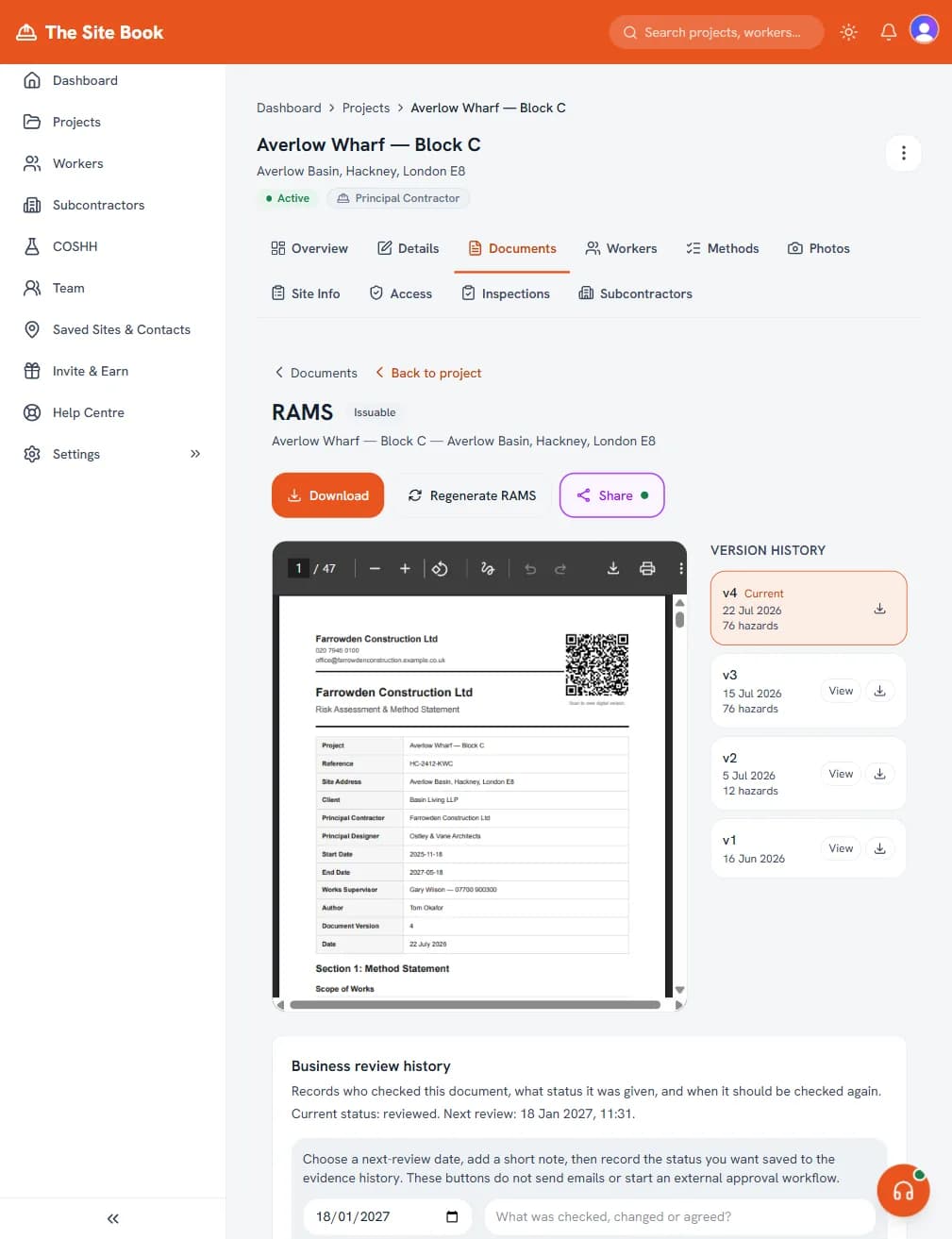
- Generate a site-specific RAMS first draft from a natural-language brief in under five minutes, ready for competent-person review - not a template library you hand-fill.
- Controlled document workflow without an enterprise contract: version history and a recorded issue confirmation before a document is shared with a client or downloaded in the app on every plan, re-sign on revision with superseded signatures preserved plus PCPP import, cert tracking and document checking from the £39/month Pro plan - and on Business, optional named-approver routing (a designated approver accepts or rejects each version, with recorded reasons, before it can be issued) plus client approve/reject/request-changes via share links.
- Transparent pricing: Starter £0, Pro £39/month or £360/year, Business £199/month with 10 management logins and 50 active site portal users. Worker document signing has no per-signature charge; project workers count as active portal users while assigned.
- Build RAMS for any trade - add your own work types and method statements alongside the built-in library, reusable across projects, including a ready-made Commercial Solar PV group. Save a finished job as a reusable project template, or clone it, so the next job of the same shape starts from your own setup.
- COSHH goes deep: a standalone COSHH assessment document, upload-a-Safety-Data-Sheet extraction, a site-specific substance register and an expert-reviewed library - plus per-worker RAMS sign-off and a one-click Audit Pack covering documents, sign-offs, worker evidence, attendance, incidents, COSHH, permits and up to the latest 500 live Site Diary entries.
Ready to stop writing RAMS by hand?
Describe your job, get professional RAMS, CPP, and COSHH assessments in minutes. No credit card required.
Related guides
COSHH for Builders
Soldering flux, pipe cement, and other plumbing substances that need COSHH assessment.
Confined Spaces in Construction
Safe working in plant rooms, risers, and under-floor voids common in plumbing work.
Manual Handling in Construction
Moving boilers, cast iron baths, and pipe runs safely — practical guidance for plumbing contractors.
Hot Works Permits
When you need a hot works permit for soldering near combustibles or using blowtorches on pipework.