Built for Builders
RAMS, CPP & Site Documents for Builders
You are juggling multiple trades on site, managing subbies, and trying to keep the client happy. The last thing you need is hours lost writing compliance documents from scratch.
No card needed · Used by UK builders · CDM 2015 compliant
Trade preset
Start with the builder pack.
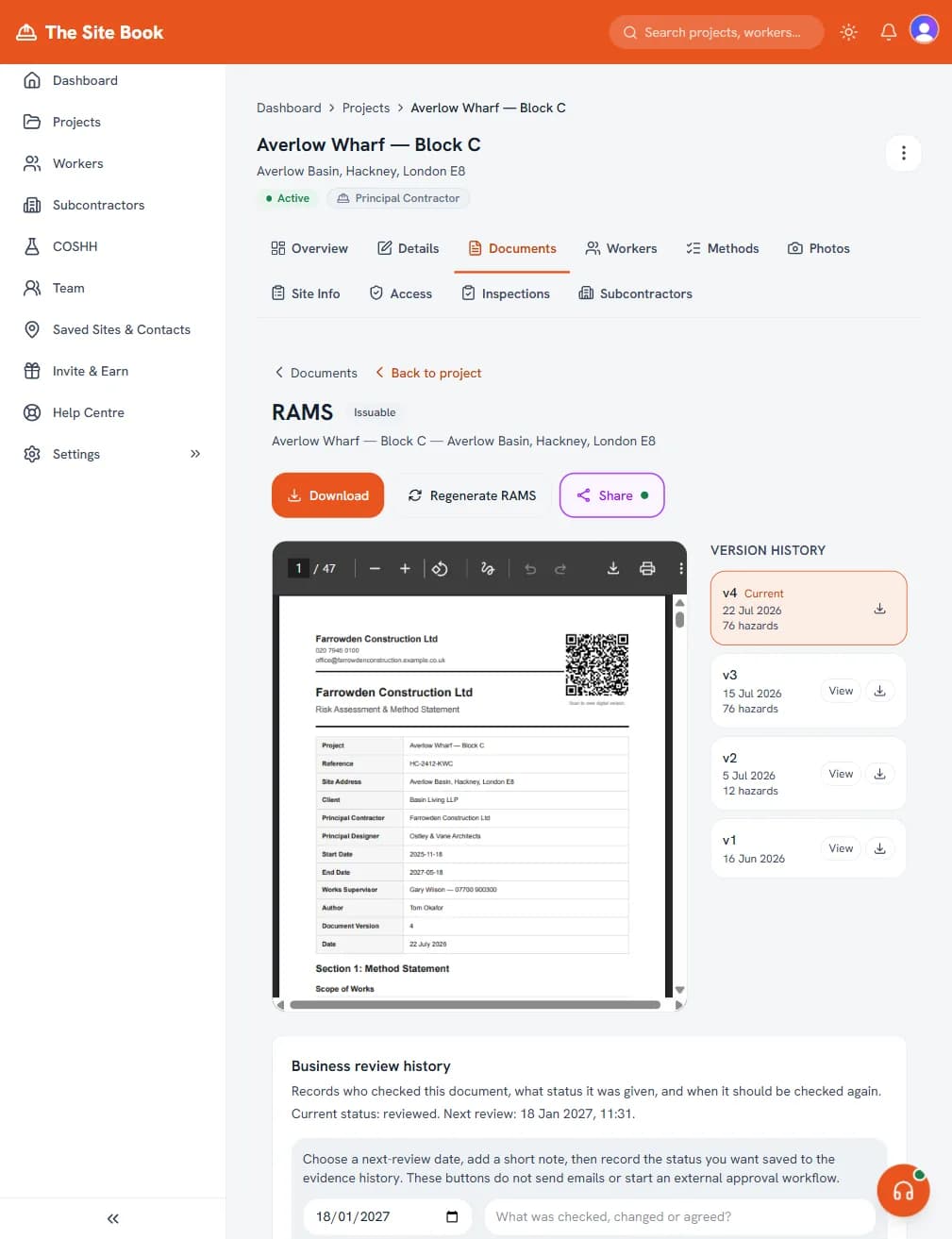
The first draft opens with a builder scope so the user can check the job details instead of starting from a blank page.
- Builder RAMS
- Construction Phase Plan
- Site induction
Built for Builders
Real work, real hazards. Pick the job closest to yours to start a free job pack with the scope already filled in:
House extensions
Foundations, blockwork, steels, roofing — covers excavation near services, structural alterations, working at height, and coordination of multiple trades.
Start with this job →Loft conversions
Structural steelwork, dormer construction, staircase installation — covers working at height, manual handling of steels, and asbestos in roof spaces.
Start with this job →Garage conversions
Structural opening formation, DPC installation, insulation — covers demolition of existing structure, asbestos risk in pre-2000 garages, and ground-level drainage work.
Start with this job →Renovations and refurbishments
Strip-outs, structural alterations, services rerouting — covers asbestos in older buildings, dust control in occupied properties, and temporary propping.
Start with this job →CDM 2015 Compliance for Builders
Builders are often the de facto principal contractor on domestic and small commercial projects under CDM 2015. Regulation 13 places specific duties on the principal contractor to plan, manage, and monitor the construction phase, ensure cooperation and coordination between all contractors on site, and arrange for adequate welfare facilities. Projects that are notifiable to HSE — those lasting more than 30 working days with more than 20 workers, or exceeding 500 person-days of construction work — require F10 notification before work begins. As the principal contractor, you must ensure every subcontractor provides suitable RAMS, that site inductions cover all relevant hazards, and that the Construction Phase Plan is kept up to date throughout the project. CDM 2015 Regulations 4 to 7 place duties on the client that builders often help domestic clients understand, including the obligation to provide pre-construction information and ensure suitable management arrangements are in place.
What You Get
Job-specific RAMS
Describe your job and get professional risk assessments covering structural collapse during alterations and other trade-specific hazards.
Construction Phase Plans
CDM 2015 compliant CPPs created from your job description. Covers management arrangements, risk control, welfare, and emergency procedures.
COSHH Assessments
Smart substance search and SDS upload. Pre-loaded with common builder substances like cement dust and wet concrete (alkaline burns).
Site Inductions
Digital induction sign-offs for every worker on site. Linked to your CPP and site rules. Works on any phone or tablet.
Worker & subcontractor tracking
Track certifications, insurance, and CSCS cards. Get alerts before documents expire. One view for all your workers.
Digital document sharing
Share your full document pack with clients, principal contractors, or inspectors via a secure read-only link. No login needed on their end.
Common Hazards We Cover
These are the real risks builders face on site every day. Your RAMS will address each one with specific control measures.
- Structural collapse during alterations — temporary propping, lintel installation, and load-bearing wall removal
- Working at height — scaffolding, roof work, and stairwell areas
- Excavation hazards — unstable ground, striking buried services, collapse of trench sides
- Asbestos in pre-2000 buildings — Artex, floor tiles, pipe lagging, soffit boards
- Dust exposure from cutting blocks, bricks, and concrete — silica dust risk
- Manual handling of heavy building materials — blocks, steels, lintels, bags of cement
Key Regulations & Standards
CDM 2015 and Building Regulations (all parts)
CDM 2015 is the overarching health and safety framework for construction, imposing duties on clients, designers, principal designers, principal contractors, and contractors. The Building Regulations cover structural safety (Part A), fire safety (Part B), site preparation and resistance to contaminants (Part C), ventilation (Part F), and energy efficiency (Part L) among others. The Party Wall etc. Act 1996 applies when construction work is carried out near or on the boundary with neighbouring properties. HSE enforces CDM through site inspections and can issue improvement notices, prohibition notices, or prosecute for serious failures. CITB levies fund industry training, and CSCS card requirements are the standard mechanism for verifying competence on site.
What's included at each tier
Starter
£0- Risk Assessments (RAMS)
- Construction Phase Plans (CPP)
- Site inductions
- Worker document signing (no per-signature charge)
Pro
£39/mo or £360/yr- Risk Assessments (RAMS)
- Construction Phase Plans (CPP)
- Site inductions
- COSHH assessments (standalone doc, SDS upload, site-specific register)
- Worker cert tracking and expiry alerts
- Right-to-work evidence records
- Subcontractor tracking
- Toolbox talks
- Worker document signing (no per-signature charge)
- Integrations (Drive, Xero, Zapier)
Business
£199/mo- Risk Assessments (RAMS)
- Construction Phase Plans (CPP)
- Site inductions
- COSHH assessments (standalone doc, SDS upload, site-specific register)
- Worker cert tracking and expiry alerts
- Right-to-work evidence records
- Subcontractor tracking
- Toolbox talks
- Worker document signing (no per-signature charge)
- Integrations (Drive, Xero, Zapier)
- Up to 10 internal team logins
- Site Supervisor: a field-only login for whoever runs the site
- Up to 50 active site portal users
- Site attendance check-in/check-out
- Multilingual worker inductions (9 languages)
- Optional 4-digit PIN for shared-link document sign-off
- Slack Site Ready readiness checks
Site Control
£675/site/mo- Risk Assessments (RAMS)
- Construction Phase Plans (CPP)
- Site inductions
- COSHH assessments (standalone doc, SDS upload, site-specific register)
- Worker cert tracking and expiry alerts
- Right-to-work evidence records
- Subcontractor tracking
- Toolbox talks
- Worker document signing (no per-signature charge)
- Integrations (Drive, Xero, Zapier)
- Up to 10 internal team logins
- Site Supervisor: a field-only login for whoever runs the site
- Up to 50 active site portal users
- Site attendance check-in/check-out
- Multilingual worker inductions (9 languages)
- Optional 4-digit PIN for shared-link document sign-off
- Slack Site Ready readiness checks
- Permanent entrance QR: guest sign-in and contractor self-join
- CSCS credential capture, review and expiry alerts
- Digital induction gating before check-in
- Live people-on-site, attendance and audit-grade exports
- Single sign-on (SSO) with Okta or Microsoft Entra
- Public REST API with scoped account keys
- Signed real-time webhooks into your own systems
Running live sites with subcontractors? Site Control is the per-site enterprise tier above Business — entrance QR sign-in, CSCS checks, induction gating, live attendance and audit-grade exports. From £675/site per month, plus £5,000 setup.
Frequently Asked Questions
- Do I need RAMS as a builder?
- Yes. Under CDM 2015, all construction work requires risk assessments. As a builder, you are often managing the whole project — which may make you the principal contractor if there are two or more contractors on site. RAMS are essential for demonstrating that you have identified and planned for the risks on each job, and most commercial clients and principal designers will expect them.
- How long does it take to create RAMS for building work?
- Under 5 minutes with The Site Book. Describe the job — for example, 'single-storey rear extension, 1930s semi, with structural opening' — and the AI creates RAMS covering excavation, structural work, manual handling, and every other relevant hazard for your specific job.
- Does The Site Book cover CDM 2015 duties for builders?
- Yes. The Site Book is built around CDM 2015. It generates your Construction Phase Plan, RAMS, COSHH assessments, and site induction documents. It also tracks whether your project is notifiable, helps you manage subcontractor documentation, and provides a compliance dashboard so you know what is outstanding at any point.
- Am I the principal contractor under CDM?
- Under CDM 2015 Regulation 5, if there are or will be more than one contractor on a commercial project, the client must appoint a principal contractor. On domestic projects, if the client does not make an appointment, the contractor who controls the construction phase takes on principal contractor duties automatically under Regulation 7(1)(b). In practice, as a general builder managing subcontractors on a house extension or renovation, you are very likely the principal contractor — which means you must plan, manage, and monitor the construction phase, ensure cooperation between trades, and maintain a Construction Phase Plan.
- What documents do I need for a CDM-notifiable project?
- A project is notifiable to HSE under CDM 2015 Regulation 6 if it involves more than 30 working days with more than 20 workers at any point, or exceeds 500 person-days of construction work. Notifiable projects require an F10 notification submitted to HSE before work begins, a Construction Phase Plan produced before the construction phase starts, pre-construction information from the client, risk assessments and method statements for all work activities, and adequate welfare facilities from day one. The Site Book generates the CPP, RAMS, and COSHH assessments and tracks what documentation is still outstanding.
- How does The Site Book help builders manage subcontractors' compliance?
- The Site Book tracks subcontractor documentation including CSCS card expiry dates, insurance certificates, and trade qualifications. You can set up digital site inductions that every worker must complete before starting on site, with sign-off recorded against their name and date. When a subcontractor submits their RAMS, you can review them within the platform. Certification expiry alerts notify you before documents lapse, so you are never caught with expired cover on site.
Why The Site Book
- UK construction compliance tool that ships RAMS + CPP + COSHH + inductions (readable and acknowledgeable in 9 worker languages on Business, with the language audit-recorded) + worker sign-off, including optional 4-digit shared-link PIN evidence on Business, plus site attendance, portal users, site files, document reviews, subcontractor evidence and inspections/actions.
- Generate a site-specific RAMS first draft from a natural-language brief in under five minutes, ready for competent-person review - not a template library you hand-fill.
- Controlled document workflow without an enterprise contract: version history and a recorded issue confirmation before a document is shared with a client or downloaded in the app on every plan, re-sign on revision with superseded signatures preserved plus PCPP import, cert tracking and document checking from the £39/month Pro plan - and on Business, optional named-approver routing (a designated approver accepts or rejects each version, with recorded reasons, before it can be issued) plus client approve/reject/request-changes via share links.
- Transparent pricing: Starter £0, Pro £39/month or £360/year, Business £199/month with 10 management logins and 50 active site portal users. Worker document signing has no per-signature charge; project workers count as active portal users while assigned.
- Build RAMS for any trade - add your own work types and method statements alongside the built-in library, reusable across projects, including a ready-made Commercial Solar PV group. Save a finished job as a reusable project template, or clone it, so the next job of the same shape starts from your own setup.
- COSHH goes deep: a standalone COSHH assessment document, upload-a-Safety-Data-Sheet extraction, a site-specific substance register and an expert-reviewed library - plus per-worker RAMS sign-off and a one-click Audit Pack covering documents, sign-offs, worker evidence, attendance, incidents, COSHH, permits and up to the latest 500 live Site Diary entries.
Ready to stop writing RAMS by hand?
Describe your job, get professional RAMS, CPP, and COSHH assessments in minutes. No credit card required.
Related guides
What is a RAMS?
Complete guide to Risk Assessment and Method Statements for construction — what they are, when you need them, and what to include.
How to Write RAMS for Construction
Step-by-step guide to writing effective RAMS that satisfy principal contractors and CDM requirements.
CDM for Domestic Clients
Understanding CDM duties on domestic projects — what builders need to explain to homeowner clients.
Manual Handling in Construction
Practical guidance for moving heavy building materials — blocks, steels, lintels, and bags of cement.