Construction compliance guide
What is RAMS?
A builder’s guide to Risk Assessments and Method Statements. What they are, when you need them, what goes in them, and the mistakes that catch people out.
TL;DR
A builder’s guide to Risk Assessments and Method Statements. What they are, when you need them, what goes in them, and the mistakes that catch people out.
In this guide
What is RAMS?
RAMS stands for Risk Assessment and Method Statement. It is actually two documents combined into one, and it is one of the most commonly requested pieces of paperwork in UK construction.
The risk assessment part identifies the hazards associated with a piece of work, evaluates the likelihood and severity of harm, and sets out the control measures you will put in place to manage those risks. It answers the question: “What could go wrong, and what are we doing to prevent it?”
The method statement part describes the step-by-step process for carrying out the work safely. It incorporates the control measures from the risk assessment and lays out the sequence of operations, the equipment to be used, the PPE required, and the emergency procedures in place. It answers the question: “How exactly are we going to do this work safely?”
Together, these two documents form a complete safety plan for a specific piece of work, as outlined in the HSE’s guidance on risk assessment. Principal contractors will often ask to see your RAMS before they allow you on site, and clients increasingly expect them even on domestic jobs.
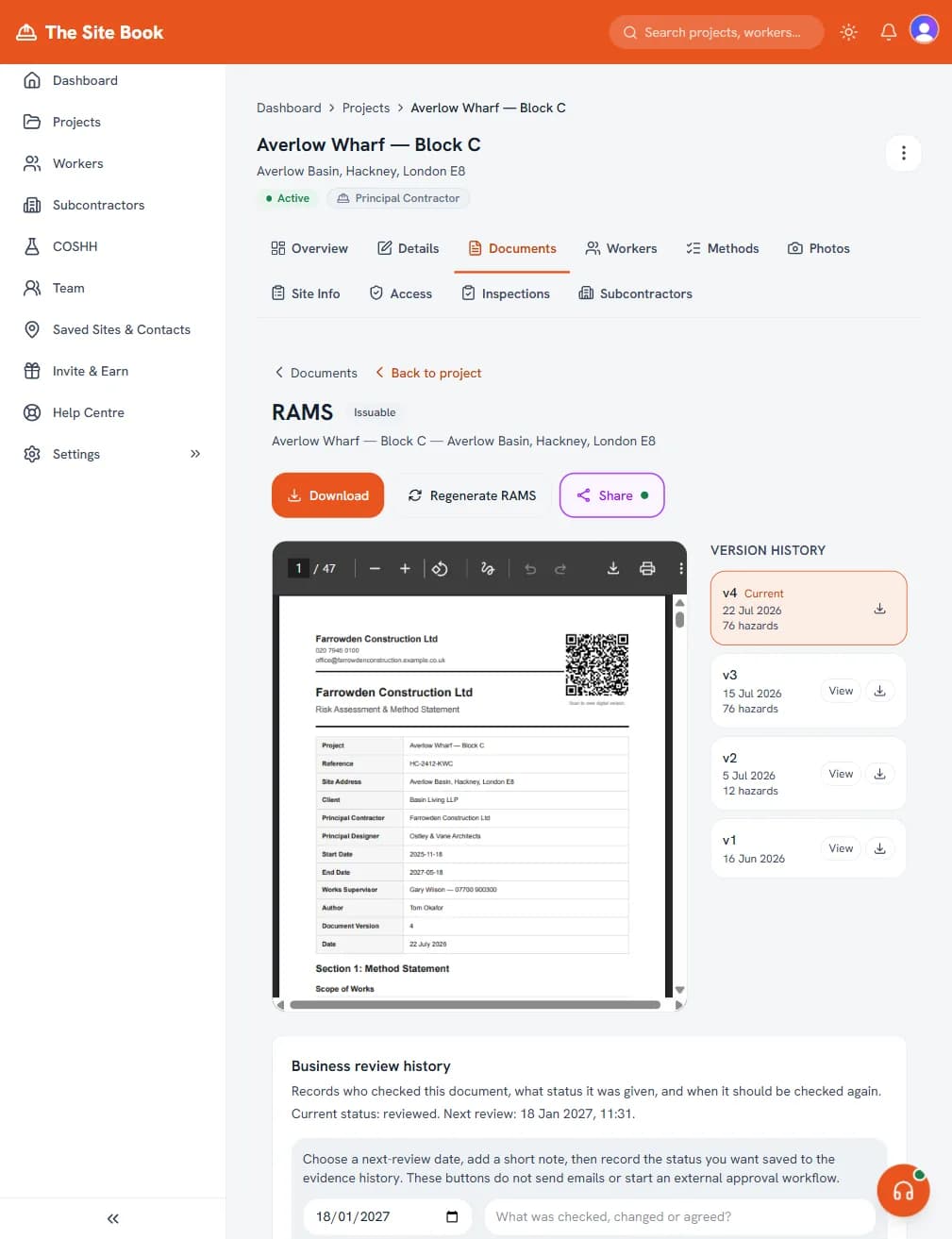
A generated RAMS in The Site Book
When do you need RAMS?
You need a RAMS for any construction activity that involves significant risk. In practice, that covers the vast majority of trade work. Here are some common examples:
- Working at height — roofing, scaffolding, ladder work, loft access
- Demolition and structural alterations
- Excavation and groundworks
- Electrical work, especially near live circuits
- Hot works — welding, cutting, use of blowtorches
- Working with or near asbestos-containing materials
- Handling hazardous substances — adhesives, solvents, cement, silica dust
- Confined space entry
- Lifting operations with cranes or hoists
- Working near underground or overhead services
If you are asked for a RAMS by a principal contractor, client, or site manager, you should provide one. Even if the specific activity is not high-risk, having a RAMS demonstrates professionalism and shows you have thought about safety before starting work.
What goes in a RAMS?
A good RAMS covers several key areas. Here is what you should include:
Hazard identification
List every hazard associated with the work. Be specific — do not just write ‘working at height.’ Describe the actual scenario: ‘installing roof tiles at 6m height on a pitched roof with limited edge protection.’ The more specific you are, the more useful the assessment becomes.
Risk rating
For each hazard, assess the likelihood of harm occurring and the potential severity. Most RAMS use a simple matrix: likelihood (1–5) multiplied by severity (1–5) gives a risk rating. This helps you prioritise which risks need the most attention and the strongest controls.
Control measures
For each hazard, describe the measures you will put in place to reduce the risk. Follow the hierarchy of controls: eliminate the hazard if possible, substitute for something less dangerous, use engineering controls, then administrative controls, and finally PPE as a last resort. Be specific about what you will actually do.
Method of work
Describe the step-by-step process for carrying out the work safely. This is the method statement part. Include the sequence of operations, the tools and equipment to be used, and any specific precautions at each stage.
PPE requirements
List the personal protective equipment required for the work. Be specific: hard hat, safety boots with ankle support, hi-vis vest, safety glasses, hearing protection, dust mask (FFP3 for silica), gloves. Do not just write ‘appropriate PPE’ — name the items.
Emergency procedures
Describe what to do if something goes wrong. This should cover first aid arrangements, the location of the nearest A&E, the fire assembly point, how to report an incident, and any specific emergency procedures for the work (such as rescue from height).
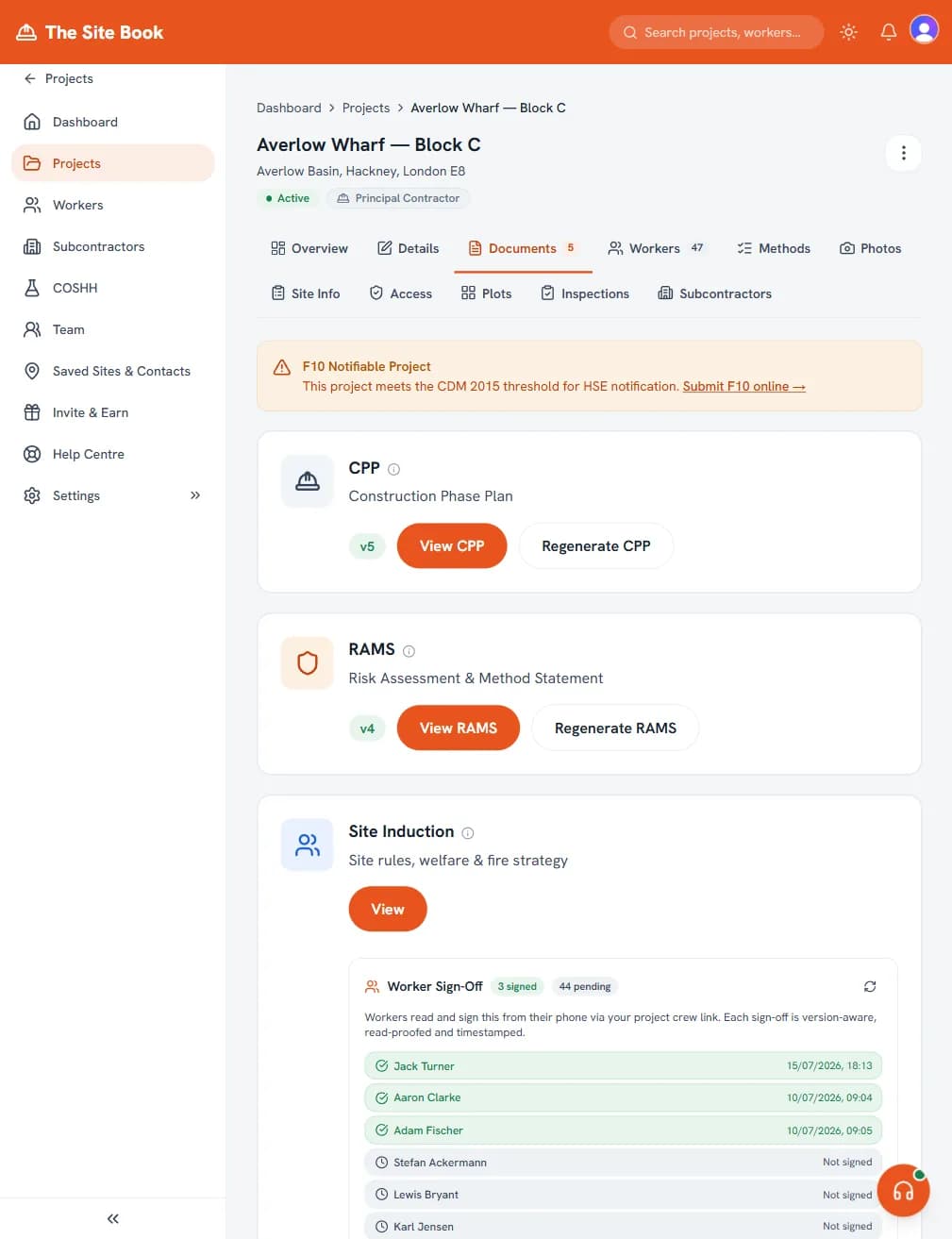
Your RAMS alongside other project documents
Common mistakes builders make with RAMS
We see the same problems come up again and again. Here are the most common mistakes and how to avoid them:
Using a generic template without tailoring it
The single biggest mistake. You download a template from the internet, put your company name at the top, and send it out. The problem is that a generic template does not cover the specific hazards on your specific site. If there is an incident and the HSE investigates, a generic RAMS will not demonstrate that you assessed the actual risks. Every RAMS must be site-specific.
Not reviewing or updating the RAMS
You wrote the RAMS before you started, and now it is three weeks later and the site conditions have changed. New hazards have appeared, a subcontractor has turned up with equipment you did not expect, and the weather has made the ground conditions worse. If your RAMS does not reflect the current reality on site, it is not meeting the legal standard.
Writing it after the work is done
This happens more often than anyone wants to admit. The principal contractor asks for your RAMS, and you write it retrospectively. Apart from being dishonest, this completely defeats the purpose. A risk assessment is meant to be done before the work starts, so you can identify hazards and put controls in place. Writing it afterwards provides no safety benefit whatsoever.
Making it too vague
Phrases like ‘appropriate PPE will be worn’ or ‘all necessary precautions will be taken’ are meaningless. Your RAMS should be specific enough that someone unfamiliar with the job could read it and understand exactly what hazards exist and what controls are in place. Name the PPE. Describe the controls. Be precise.
Not sharing it with the workers
A RAMS that sits in a filing cabinet or in your email inbox is not protecting anyone. The people doing the work need to know what the hazards are and what controls are in place. Brief your team on the RAMS before work starts, and make sure everyone has access to it.
How The Site Book creates site-specific RAMS
The Site Book takes a different approach to RAMS. Instead of handing you a blank template, it asks you to describe your job in plain English — or just talk into your phone. It then extracts the relevant details and pre-fills your RAMS with site-specific information.
The guided wizard takes you through six steps: project basics, site information, personnel, works description, hazards, and a final review. At each stage, it suggests hazards, control measures, and method steps based on the type of work you are doing and the site conditions you have described.
The result is a RAMS that is genuinely tailored to your project — not a generic template with your name at the top. It names your site, describes your actual working conditions, lists the real hazards you will encounter, and sets out the controls you are actually going to use. You review everything before creating, so you are always in control of the final document.
The output is a professionally formatted, company-branded PDF that you can download, print, share with your principal contractor, or hand to a client. It looks the part and meets the legal standard — without you spending hours wrestling with a Word document.
RAMS at a glance — wins and watchouts for site-specific RAMS
Pros
- Industry-standard format: principal contractors, clients and insurers know what a RAMS looks like and accept it.
- Combines risk assessment + method statement in one document — aligns with MHSW 1999 + CDM 2015 in a single deliverable.
- Demonstrates due diligence: a site-specific RAMS is strong evidence you thought through the hazards before work began.
- Reusable with tailoring: template-plus-edit is faster than starting from a blank page for each job.
Cons
- ‘RAMS’ is not defined in legislation — the required standard is ‘suitable and sufficient,’ so a generic template can still leave you exposed.
- Must be site-specific: a template for ‘general roofing’ will not cover the fragile roof light at 14 Acacia Avenue.
- Needs live review: site conditions, subcontractors and weather change the risk profile — a write-once RAMS drifts fast.
- Must be briefed out: a RAMS in a drawer protects nobody — workers need to read and understand it before they start.
| Document | What it covers | When it is used |
|---|---|---|
| Risk Assessment | Identifies hazards, evaluates likelihood + severity, sets controls. | Required by MHSW 1999 for any work with significant risk. |
| Method Statement | Step-by-step safe sequence of work incorporating the controls. | Used for high-risk activities and often requested by PCs before mobilisation. |
| Combined RAMS | Both documents merged into one site-specific file. | Industry standard for construction work — what PCs typically ask for. |
| Generic template RAMS | Pre-written hazards + controls for a trade (e.g. ‘roofing’). | Starting point only — must be tailored to the actual site. |
“The law does not expect you to eliminate all risk, but you are required to protect people as far as ‘reasonably practicable’.”
Frequently asked questions
What does RAMS stand for?
RAMS stands for Risk Assessment and Method Statement. It is a single document that combines two things: a risk assessment, which identifies the hazards in a piece of work and the control measures that will manage them, and a method statement, which sets out the step-by-step sequence for doing the work safely. In UK construction, RAMS is the standard document a principal contractor or client asks to see before you start on site.
How long does it take to write a RAMS?
Writing a RAMS from scratch in Word is slow, even for a straightforward trade job — most of the time goes on describing hazards, controls, and the work sequence in enough site-specific detail to be useful. Working from a tailored template is faster but still needs careful editing so it reflects the actual site. RAMS software shortens the writing stage: The Site Book generates a site-specific first draft from your plain-English job description in minutes, which you then review and adjust before downloading the PDF.
Is RAMS a legal requirement?
The term ‘RAMS’ is not explicitly used in UK health and safety legislation. However, the underlying requirements are clear. Under the Management of Health and Safety at Work Regulations 1999, every employer (including sole traders) must carry out a suitable and sufficient assessment of the risks to workers and anyone else affected by their work. For construction work, CDM 2015 reinforces this by requiring contractors to plan, manage, and monitor work to ensure it is carried out safely. In practice, RAMS is the standard format the construction industry uses to meet these legal obligations. If you are doing construction work with significant risks — which covers the vast majority of trade work — you should have a RAMS.
What’s the difference between a risk assessment and a method statement?
A risk assessment identifies the hazards associated with a piece of work, evaluates how likely someone is to be harmed and how severe that harm could be, and sets out the control measures you will put in place to reduce the risk to an acceptable level. A method statement describes the step-by-step process for carrying out the work safely, incorporating the control measures identified in the risk assessment. Think of the risk assessment as the ‘what could go wrong and how do we prevent it’ part, and the method statement as the ‘here is exactly how we will do the work’ part. In practice, they are almost always combined into a single document — your RAMS.
Do I need RAMS for every job?
You need a risk assessment for any work that involves significant risk, and in construction, that covers the vast majority of jobs. Working at height, using power tools, handling hazardous materials, working near live services, demolition, excavation, hot works — all of these require a risk assessment at minimum. For very low-risk activities, you can use a generic assessment, but it must still be reviewed and confirmed as relevant to the specific site. In practice, if you are doing any kind of construction or trade work on a building site, you should have a RAMS. It protects your workers, demonstrates your competence to clients and principal contractors, and provides evidence of due diligence if anything goes wrong.
Can I use a generic RAMS template?
Using a completely generic template is not recommended and may not meet the legal standard of being ‘suitable and sufficient.’ Your risk assessment must reflect the actual risks on the actual site where you are working. A template for ‘general roofing work’ will not cover the specific hazards at 14 Acacia Avenue — the fragile roof light, the overhead power line, the narrow access. That said, there is nothing wrong with starting from a template and tailoring it. The key is that the final document must be site-specific: it should name the site, describe the actual conditions, identify the real hazards, and set out the controls you are actually going to use. The Site Book solves this by creating your RAMS from your project description, so it is site-specific from the start.
How often should RAMS be reviewed?
Your RAMS should be reviewed before each new phase of work, after any incident or near miss, when site conditions change significantly (for example, new hazards are introduced or weather conditions change the risk profile), when new workers or subcontractors join the project, and at regular intervals on longer projects. A RAMS that was written on day one and never updated is not meeting the legal requirement. If you discover a new risk on site that was not in your original assessment, you need to update the RAMS before continuing work. The review does not need to be a formal process — it can be as simple as reading through the document at the start of each week and confirming it still reflects reality.
Create your RAMS in minutes
Now you know what RAMS is — let The Site Book create yours. Describe the job, pick the hazards, download a professional PDF.
See how it works →Ready to create your RAMS?
Skip the blank template. Describe your job in plain English and get a site-specific RAMS created in minutes — free.
Related guides
CDM 2015 for Small Builders
Your duties under CDM 2015, explained without the jargon.
What is a Construction Phase Plan?
A plain-English guide to CPPs for UK builders.
Site Inductions Guide
What to cover, how to run one, and why digital beats paper.
RAMS Example
A worked RAMS for a real job, section by section — what good looks like.
Free RAMS Template
Every section a RAMS needs — download the structure or create one pre-filled.
Best RAMS Software UK
RAMS generators compared on features and price.
Get a free RAMS checklist emailed to you
No spam. Just the free resource. Unsubscribe any time.
Create site-specific RAMS in minutes.
Describe your job, walk through the wizard, and get your Risk Assessment and Method Statement pre-filled. No credit card required.
Sources
- Management of Health and Safety at Work Regulations 1999 — legislation.gov.uk · Accessed 17 April 2026
- Construction (Design and Management) Regulations 2015 — legislation.gov.uk · Accessed 17 April 2026
- L153: Managing health and safety in construction — HSE · Accessed 17 April 2026