Built for Roofers
RAMS, CPP & Site Documents for Roofers
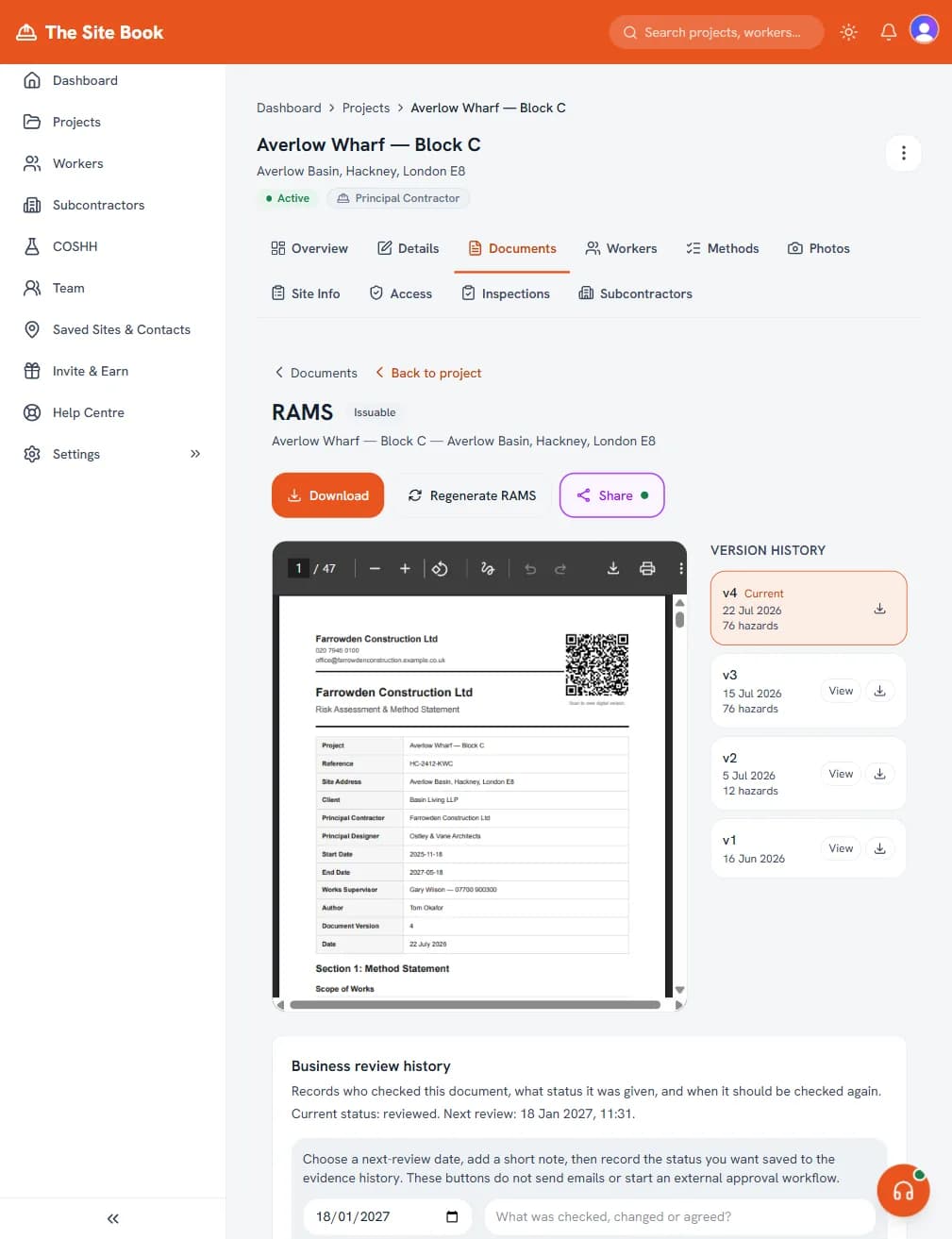
Roofing is one of the highest-risk trades in construction. Your RAMS need to be specific, not a generic template. Get professional documents that reflect real roofing hazards.
No card needed · Used by UK roofers · CDM 2015 compliant
Trade preset
Start with the roofer pack.
The first draft opens with a roofer scope so the user can check the job details instead of starting from a blank page.
- Roofing RAMS
- Construction Phase Plan
- Site induction
Built for Roofers
Real work, real hazards. Pick the job closest to yours to start a free job pack with the scope already filled in:
Pitched roof re-tiles
Stripping and re-tiling, batten replacement, felt and membrane installation — covers working at height, fragile materials, and manual handling of tiles.
Start with this job →Flat roof felt and single-ply
Torch-on felt, single-ply membrane, insulation boards — covers hot works, fire risk from torches, and fume exposure from bitumen.
Start with this job →Leadwork and flashing
Lead flashing, valley gutters, chimney flashings — covers lead dust exposure, manual handling of lead sheet, and working at height on exposed positions.
Start with this job →Fascia, soffit, and guttering
Replacement of fascia boards, soffits, and rainwater goods — covers working from ladders, asbestos in old soffit boards, and manual handling at height.
Start with this job →CDM 2015 Compliance for Roofers
Roofing is statistically the most dangerous construction trade in the UK. HSE data shows that falls from height account for over 25% of construction fatalities, with roofing work disproportionately represented in these figures. CDM 2015 places specific duties on roofing contractors under Regulation 15: planning for fall prevention using the hierarchy of controls, identifying fragile surfaces before work starts, and ensuring adequate edge protection or safety netting is in place before anyone accesses the roof. The Work at Height Regulations 2005 require a systematic approach — avoid work at height where possible, use work platforms with edge protection where avoidance is not practicable, and use personal fall arrest equipment only as a last resort. Pre-start checks are critical: scaffold must be inspected by a competent person under NASC SG4:15 guidelines, fragile surface surveys must identify rooflights, cement fibre sheets, and deteriorated felt, and weather risk assessments must set clear wind speed limits for exposed positions. HSE guidance document INDG284 'Working on roofs' provides the practical framework that every roofing RAMS should reference.
What You Get
Job-specific RAMS
Describe your job and get professional risk assessments covering falls from height and other trade-specific hazards.
Construction Phase Plans
CDM 2015 compliant CPPs created from your job description. Covers management arrangements, risk control, welfare, and emergency procedures.
COSHH Assessments
Smart substance search and SDS upload. Pre-loaded with common roofer substances like bitumen fume from torch-on felt roofing.
Site Inductions
Digital induction sign-offs for every worker on site. Linked to your CPP and site rules. Works on any phone or tablet.
Worker & subcontractor tracking
Track certifications, insurance, and CSCS cards. Get alerts before documents expire. One view for all your workers.
Digital document sharing
Share your full document pack with clients, principal contractors, or inspectors via a secure read-only link. No login needed on their end.
Common Hazards We Cover
These are the real risks roofers face on site every day. Your RAMS will address each one with specific control measures.
- Falls from height — the leading cause of fatal injuries in roofing, including falls from edges, through fragile surfaces, and from ladders
- Fragile roof surfaces — cement fibre sheets, rooflights, skylights, and deteriorated felt that will not support body weight
- Manual handling of heavy materials at height — tile bundles, lead rolls, and insulation boards carried up ladders or hoisted by crane
- Hot works — torch-on felt roofing creates fire risk, particularly near timber decking and insulation
- Asbestos — cement fibre roof sheets, soffits, and downpipes on pre-2000 buildings are likely to contain asbestos
- Weather exposure — wind loading at height, rain on slippery surfaces, cold stress in winter, UV and heat in summer
Key Regulations & Standards
Work at Height Regulations 2005 and HSE guidance INDG284 (Working on Roofs)
The Work at Height Regulations 2005 require a risk assessment before any roof work, application of the hierarchy of controls, and competent person oversight for all working platforms. HSE INDG284 provides scenario-specific guidance for pitched roofs, flat roofs, and fragile surfaces. The Lifting Operations and Lifting Equipment Regulations 1998 (LOLER) apply to material hoists and crane lifts delivering tiles, battens, and lead sheet to roof level — all lifting equipment must be inspected and certified. The Control of Asbestos Regulations 2012 are relevant for cement fibre sheet roofs and soffits on pre-2000 buildings, requiring a refurbishment and demolition survey before stripping. CDM 2015 Regulation 10 requires principal designers to identify fragile surfaces in pre-construction information. NFRC (National Federation of Roofing Contractors) publishes health and safety guidance specific to roofing operations.
What's included at each tier
Starter
£0- Risk Assessments (RAMS)
- Construction Phase Plans (CPP)
- Site inductions
- Worker document signing (no per-signature charge)
Pro
£39/mo or £360/yr- Risk Assessments (RAMS)
- Construction Phase Plans (CPP)
- Site inductions
- COSHH assessments (standalone doc, SDS upload, site-specific register)
- Worker cert tracking and expiry alerts
- Right-to-work evidence records
- Subcontractor tracking
- Toolbox talks
- Worker document signing (no per-signature charge)
- Integrations (Drive, Xero, Zapier)
Business
£199/mo- Risk Assessments (RAMS)
- Construction Phase Plans (CPP)
- Site inductions
- COSHH assessments (standalone doc, SDS upload, site-specific register)
- Worker cert tracking and expiry alerts
- Right-to-work evidence records
- Subcontractor tracking
- Toolbox talks
- Worker document signing (no per-signature charge)
- Integrations (Drive, Xero, Zapier)
- Up to 10 internal team logins
- Site Supervisor: a field-only login for whoever runs the site
- Up to 50 active site portal users
- Site attendance check-in/check-out
- Multilingual worker inductions (9 languages)
- Optional 4-digit PIN for shared-link document sign-off
- Slack Site Ready readiness checks
Site Control
£675/site/mo- Risk Assessments (RAMS)
- Construction Phase Plans (CPP)
- Site inductions
- COSHH assessments (standalone doc, SDS upload, site-specific register)
- Worker cert tracking and expiry alerts
- Right-to-work evidence records
- Subcontractor tracking
- Toolbox talks
- Worker document signing (no per-signature charge)
- Integrations (Drive, Xero, Zapier)
- Up to 10 internal team logins
- Site Supervisor: a field-only login for whoever runs the site
- Up to 50 active site portal users
- Site attendance check-in/check-out
- Multilingual worker inductions (9 languages)
- Optional 4-digit PIN for shared-link document sign-off
- Slack Site Ready readiness checks
- Permanent entrance QR: guest sign-in and contractor self-join
- CSCS credential capture, review and expiry alerts
- Digital induction gating before check-in
- Live people-on-site, attendance and audit-grade exports
- Single sign-on (SSO) with Okta or Microsoft Entra
- Public REST API with scoped account keys
- Signed real-time webhooks into your own systems
Running live sites with subcontractors? Site Control is the per-site enterprise tier above Business — entrance QR sign-in, CSCS checks, induction gating, live attendance and audit-grade exports. From £675/site per month, plus £5,000 setup.
Frequently Asked Questions
- Do I need RAMS as a roofer?
- Absolutely. Roofing is classified as high-risk work under CDM 2015 due to the inherent fall hazards. Every principal contractor will require your RAMS before allowing you on site. Even on domestic jobs, RAMS are critical — roofing accounts for more fatal falls in construction than any other trade. Your RAMS must be specific to the job, not a generic template.
- How long does it take to create RAMS for roofing work?
- Under 5 minutes with The Site Book. Describe the job — for example, 're-tile pitched roof on a 1960s semi with scaffolding' — and the AI creates RAMS covering fall protection, fragile surfaces, manual handling at height, weather conditions, and all relevant control measures.
- Does The Site Book cover the Work at Height Regulations?
- Yes. The Site Book generates RAMS that specifically address the Work at Height Regulations 2005, including hierarchy of control for fall prevention, edge protection requirements, fragile surface identification, and rescue planning. It also references HSE roofing guidance (INDG284) and covers hot works, asbestos in roof materials, and other roofing-specific hazards.
- What fall protection should be included in roofing RAMS?
- Your RAMS must follow the hierarchy of controls in the Work at Height Regulations 2005 Schedule 6. First preference is collective protection — scaffold with guard rails and toe boards to NASC SG4:15 standard, providing edge protection around the full perimeter. Second is safety netting below fragile surfaces to catch falls through rooflights or deteriorated sheeting. Harness and lanyard systems are the last resort, used only where collective protection is not reasonably practicable, and require a rescue plan before work starts. Your RAMS should specify which system is used and why the hierarchy was followed.
- Do I need a hot works permit for torch-on felt roofing?
- Yes, whenever using a gas torch near combustible materials such as timber decking, PIR insulation boards, or existing bitumen felt. The hot works permit should specify a fire watch period of at least 60 minutes after torch work ceases, fire extinguisher placement within 2 metres of the work area, and prohibited zones where torching is not permitted (near roof vents, close to party walls). The Fire Protection Association RC4 guidance provides the industry standard for hot works on roofs. The Site Book generates RAMS that include these hot works controls automatically when torch-on felt is specified.
- How does The Site Book handle weather risks for roofing?
- RAMS generated by The Site Book include weather-related controls specific to roof work: wind speed limits for exposed positions (typically 23 mph or Beaufort Force 6, reduced for scaffold-dependent work), rain and ice protocols covering non-slip footwear and suspended work thresholds, UV exposure controls for summer working including hydration and shade breaks, and cold stress management in winter. The Construction Phase Plan includes a weather monitoring requirement with clear stop-work triggers for each hazard.
Where it helps and where it doesn't
Pros
- Fragile-surface and edge-protection controls pre-filled
- Hot-works permit template ready for torch-on and lead burning
- COSHH entries for bitumen, flashing primers and cleaning solvents
- Weather-dependent scheduling notes baked into the site diary
Cons
- No live Met Office weather API — manual check before scheduling
- Scaffold inspection forms are generic (not CISRS-specific)
- No NFRC (Roofing Federation) audit template yet
Why The Site Book
- UK construction compliance tool that ships RAMS + CPP + COSHH + inductions (readable and acknowledgeable in 9 worker languages on Business, with the language audit-recorded) + worker sign-off, including optional 4-digit shared-link PIN evidence on Business, plus site attendance, portal users, site files, document reviews, subcontractor evidence and inspections/actions.
- Generate a site-specific RAMS first draft from a natural-language brief in under five minutes, ready for competent-person review - not a template library you hand-fill.
- Controlled document workflow without an enterprise contract: version history and a recorded issue confirmation before a document is shared with a client or downloaded in the app on every plan, re-sign on revision with superseded signatures preserved plus PCPP import, cert tracking and document checking from the £39/month Pro plan - and on Business, optional named-approver routing (a designated approver accepts or rejects each version, with recorded reasons, before it can be issued) plus client approve/reject/request-changes via share links.
- Transparent pricing: Starter £0, Pro £39/month or £360/year, Business £199/month with 10 management logins and 50 active site portal users. Worker document signing has no per-signature charge; project workers count as active portal users while assigned.
- Build RAMS for any trade - add your own work types and method statements alongside the built-in library, reusable across projects, including a ready-made Commercial Solar PV group. Save a finished job as a reusable project template, or clone it, so the next job of the same shape starts from your own setup.
- COSHH goes deep: a standalone COSHH assessment document, upload-a-Safety-Data-Sheet extraction, a site-specific substance register and an expert-reviewed library - plus per-worker RAMS sign-off and a one-click Audit Pack covering documents, sign-offs, worker evidence, attendance, incidents, COSHH, permits and up to the latest 500 live Site Diary entries.
Ready to stop writing RAMS by hand?
Describe your job, get professional RAMS, CPP, and COSHH assessments in minutes. No credit card required.
Related guides
Working at Height Guide
Fall prevention hierarchy, edge protection, and rescue planning — essential reading for roofing contractors.
Scaffolding Safety
Inspection requirements, load limits, and safe access for scaffold-dependent roofing work.
Asbestos Awareness for Builders
Identifying asbestos cement sheets, soffits, and downpipes on pre-2000 buildings before roofing work.
RAMS for Roof Work
Specific guidance on writing RAMS for pitched roofs, flat roofs, leadwork, and guttering.
Hot Works Permits
When torch-on felt roofing requires a hot works permit and fire watch procedures.