Built for Gas Engineers
RAMS, CPP & Site Documents for Gas Engineers
Gas work is already heavily regulated by Gas Safe. But CDM compliance is separate — and principal contractors still want RAMS that cover the construction site hazards of your work.
No card needed · Used by UK gas engineers · CDM 2015 compliant
Built for Gas Engineers
Real work, real hazards. Pick the job closest to yours to start a free job pack with the scope already filled in:
Boiler installations and replacements
Combi, system, and conventional boiler fitting — covers gas pipework, flue installation, electrical connections, and asbestos around old boilers.
Start with this job →Commercial gas pipework
Industrial and commercial gas installations — covers large-bore pipework, purging procedures, and work in plant rooms.
Start with this job →Gas main connections and meter work
New gas connections, meter installations, and governor changes — covers excavation near services, live gas exposure, and work in public areas.
Start with this job →Gas appliance servicing
Annual servicing of boilers, fires, and cookers — covers carbon monoxide risk, flue gas analysis, and lone working in domestic properties.
Start with this job →CDM 2015 Compliance for Gas Engineers
Gas engineers are already heavily regulated through Gas Safe Registration and the Gas Safety (Installation and Use) Regulations 1998, but CDM 2015 compliance is a separate legal requirement when working on construction sites. Gas work on new builds, extensions, and commercial refits falls under CDM even when the gas installation itself is fully covered by Gas Safe certification. The key CDM risks for gas engineers go beyond gas-specific hazards: working in confined spaces such as plant rooms and boiler cupboards under the Confined Spaces Regulations 1997, working at height for external flue installations and roof penetrations, and asbestos exposure around old boiler flues, pipe lagging, and boiler cupboard linings in pre-2000 properties. Principal contractors require RAMS that address both the gas-specific hazards — gas escape, carbon monoxide exposure, and burns from hot pipework — and the general construction hazards of working on a building site, including manual handling, coordination with other trades, and welfare arrangements. CDM 2015 Regulation 15 places duties on contractors to plan, manage, and monitor their own work regardless of their Gas Safe status.
What You Get
Job-specific RAMS
Describe your job and get professional risk assessments covering gas escape and explosion and other trade-specific hazards.
Construction Phase Plans
CDM 2015 compliant CPPs created from your job description. Covers management arrangements, risk control, welfare, and emergency procedures.
COSHH Assessments
Smart substance search and SDS upload. Pre-loaded with common gas engineer substances like flux and soldering fume (gas pipework) and jointing compound.
Site Inductions
Digital induction sign-offs for every worker on site. Linked to your CPP and site rules. Works on any phone or tablet.
Worker & subcontractor tracking
Track certifications, insurance, and CSCS cards. Get alerts before documents expire. One view for all your workers.
Digital document sharing
Share your full document pack with clients, principal contractors, or inspectors via a secure read-only link. No login needed on their end.
Common Hazards We Cover
These are the real risks gas engineers face on site every day. Your RAMS will address each one with specific control measures.
- Gas escape and explosion — working on live gas pipework carries the risk of uncontrolled gas release and ignition
- Carbon monoxide exposure — faulty appliances, blocked flues, and incomplete combustion produce CO, which is odourless and potentially fatal
- Burns from hot pipework, soldering, and contact with hot appliance components
- Asbestos — old boiler flue seals, pipe lagging, and boiler cupboard linings in pre-2000 properties
- Working in confined spaces — plant rooms, boiler cupboards, and ceiling voids with poor ventilation
- Lone working — domestic gas servicing often involves working alone in customers' homes
Key Regulations & Standards
Gas Safety (Installation and Use) Regulations 1998 and Gas Safe Register requirements
The Gas Safety (Installation and Use) Regulations 1998 require all gas work to be carried out by Gas Safe registered engineers, with installations properly notified and certified. Gas Safe Registration provides the competence framework for gas work, but RAMS under CDM 2015 must address site-specific hazards beyond the gas installation itself. The Confined Spaces Regulations 1997 apply to plant rooms and boiler cupboards with limited ventilation, requiring a safe system of work, atmospheric monitoring, and rescue arrangements. The Control of Asbestos Regulations 2012 are relevant for pre-2000 boiler rooms where flue seals, pipe lagging, and cupboard linings may contain asbestos. The Work at Height Regulations 2005 apply to external flue routes and roof penetrations. IGEM (Institution of Gas Engineers and Managers) publishes safety standards for gas installation and maintenance practices.
What's included at each tier
Starter
£0- Risk Assessments (RAMS)
- Construction Phase Plans (CPP)
- Site inductions
- Worker document signing (no per-signature charge)
Pro
£39/mo or £360/yr- Risk Assessments (RAMS)
- Construction Phase Plans (CPP)
- Site inductions
- COSHH assessments (standalone doc, SDS upload, site-specific register)
- Worker cert tracking and expiry alerts
- Right-to-work evidence records
- Subcontractor tracking
- Toolbox talks
- Worker document signing (no per-signature charge)
- Integrations (Drive, Xero, Zapier)
Business
£199/mo- Risk Assessments (RAMS)
- Construction Phase Plans (CPP)
- Site inductions
- COSHH assessments (standalone doc, SDS upload, site-specific register)
- Worker cert tracking and expiry alerts
- Right-to-work evidence records
- Subcontractor tracking
- Toolbox talks
- Worker document signing (no per-signature charge)
- Integrations (Drive, Xero, Zapier)
- Up to 10 internal team logins
- Site Supervisor: a field-only login for whoever runs the site
- Up to 50 active site portal users
- Site attendance check-in/check-out
- Multilingual worker inductions (9 languages)
- Optional 4-digit PIN for shared-link document sign-off
- Slack Site Ready readiness checks
Site Control
£675/site/mo- Risk Assessments (RAMS)
- Construction Phase Plans (CPP)
- Site inductions
- COSHH assessments (standalone doc, SDS upload, site-specific register)
- Worker cert tracking and expiry alerts
- Right-to-work evidence records
- Subcontractor tracking
- Toolbox talks
- Worker document signing (no per-signature charge)
- Integrations (Drive, Xero, Zapier)
- Up to 10 internal team logins
- Site Supervisor: a field-only login for whoever runs the site
- Up to 50 active site portal users
- Site attendance check-in/check-out
- Multilingual worker inductions (9 languages)
- Optional 4-digit PIN for shared-link document sign-off
- Slack Site Ready readiness checks
- Permanent entrance QR: guest sign-in and contractor self-join
- CSCS credential capture, review and expiry alerts
- Digital induction gating before check-in
- Live people-on-site, attendance and audit-grade exports
- Single sign-on (SSO) with Okta or Microsoft Entra
- Public REST API with scoped account keys
- Signed real-time webhooks into your own systems
Running live sites with subcontractors? Site Control is the per-site enterprise tier above Business — entrance QR sign-in, CSCS checks, induction gating, live attendance and audit-grade exports. From £675/site per month, plus £5,000 setup.
Frequently Asked Questions
- Do I need RAMS as a gas engineer?
- Yes. Being Gas Safe registered covers your competence to work on gas — but CDM 2015 compliance is separate. On construction sites, principal contractors require RAMS that cover the specific hazards of your gas work on that site, including gas escape procedures, hot work, working at height for flue installations, and asbestos exposure in older buildings.
- How long does it take to create RAMS for gas work?
- Under 5 minutes with The Site Book. Describe the job — for example, 'combi boiler replacement in a 1970s mid-terrace with external flue' — and the AI generates RAMS covering gas isolation, flue installation at height, asbestos risk in older properties, and all relevant control measures.
- Does The Site Book cover Gas Safe and GSIUR?
- The Site Book covers the health and safety aspects of gas work under CDM 2015 and references the Gas Safety (Installation and Use) Regulations 1998 where they affect safe working practices on site. It does not replace your Gas Safe registration, gas work notifications, or certification. What it does is ensure your RAMS properly address gas-specific hazards alongside general construction risks.
- What should gas engineers include in a Construction Phase Plan?
- Your CPP should cover emergency procedures for gas leaks including isolation point identification, evacuation zones, and notification of the gas transporter. It must address coordination with electrical contractors for equipotential bonding requirements under BS 7671, and flue position compliance with both manufacturer instructions and Building Regulations Part J (combustion appliances and fuel storage). Under CDM 2015 Regulation 12, the CPP must detail management arrangements for gas work phases — particularly the sequence of isolation, purging, testing, and commissioning stages.
- Do I need COSHH assessments for gas engineering work?
- Yes, for several substances commonly used in gas work. Flux fumes from soldering copper pipework, jointing compound for gas fittings, thread sealant tape dust, and cleaning solvents for degreasing all require COSHH assessment under the Control of Substances Hazardous to Health Regulations 2002. Note that carbon monoxide is not classified as a substance under COSHH — it is covered separately under GSIUR 1998 and the Health and Safety at Work Act 1974 — but CO exposure must still be addressed in your RAMS with specific controls including CO detection equipment and ventilation requirements.
- How does CDM apply to domestic boiler replacements?
- Domestic boiler replacements are construction work under CDM 2015 Regulation 2. The homeowner is the domestic client under Regulation 7, and the gas engineer as sole contractor automatically takes on both contractor duties (Regulation 15) and principal contractor duties (Regulation 13) where no other appointment is made. This means you must plan, manage, and monitor the work, ensure welfare facilities are available, and produce a proportionate Construction Phase Plan if requested. The CDM duties are separate from and additional to your Gas Safe obligations — compliance with one does not satisfy the other.
Why The Site Book
- UK construction compliance tool that ships RAMS + CPP + COSHH + inductions (readable and acknowledgeable in 9 worker languages on Business, with the language audit-recorded) + worker sign-off, including optional 4-digit shared-link PIN evidence on Business, plus site attendance, portal users, site files, document reviews, subcontractor evidence and inspections/actions.
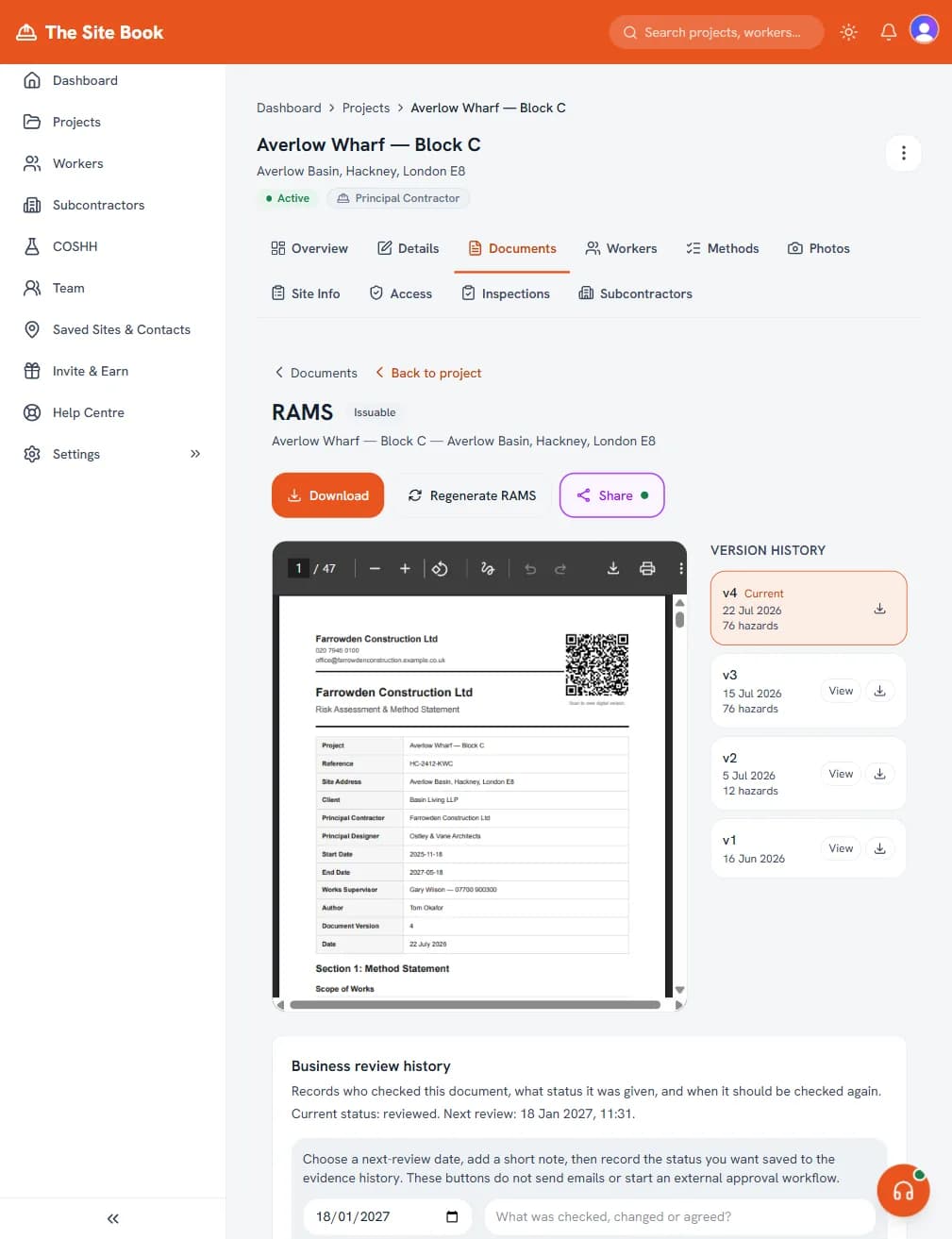
- Generate a site-specific RAMS first draft from a natural-language brief in under five minutes, ready for competent-person review - not a template library you hand-fill.
- Controlled document workflow without an enterprise contract: version history and a recorded issue confirmation before a document is shared with a client or downloaded in the app on every plan, re-sign on revision with superseded signatures preserved plus PCPP import, cert tracking and document checking from the £39/month Pro plan - and on Business, optional named-approver routing (a designated approver accepts or rejects each version, with recorded reasons, before it can be issued) plus client approve/reject/request-changes via share links.
- Transparent pricing: Starter £0, Pro £39/month or £360/year, Business £199/month with 10 management logins and 50 active site portal users. Worker document signing has no per-signature charge; project workers count as active portal users while assigned.
- Build RAMS for any trade - add your own work types and method statements alongside the built-in library, reusable across projects, including a ready-made Commercial Solar PV group. Save a finished job as a reusable project template, or clone it, so the next job of the same shape starts from your own setup.
- COSHH goes deep: a standalone COSHH assessment document, upload-a-Safety-Data-Sheet extraction, a site-specific substance register and an expert-reviewed library - plus per-worker RAMS sign-off and a one-click Audit Pack covering documents, sign-offs, worker evidence, attendance, incidents, COSHH, permits and up to the latest 500 live Site Diary entries.
Ready to stop writing RAMS by hand?
Describe your job, get professional RAMS, CPP, and COSHH assessments in minutes. No credit card required.
Related guides
COSHH for Builders
Soldering flux, jointing compound, and gas-related substances that need COSHH assessment.
Confined Spaces in Construction
Safe working in plant rooms, boiler cupboards, and ceiling voids — common environments for gas work.
Asbestos Awareness for Builders
Identifying asbestos in boiler flue seals, pipe lagging, and cupboard linings in pre-2000 buildings.